
The Next Operating System
From Information Networks to Symbiotic Civilization

1. Introduction: The Mirror of Connection
At the heart of life lies one thing: connection.
From the tiniest cell to the vastest civilization, all living systems depend on exchanging signals—information, energy, resources. This web of connection is what creates order, enables growth, and sustains life.
For humanity, this web has always taken a special form: information networks. As Yuval Noah Harari explores in Nexus, these networks—myths, stories, religious texts, laws, bureaucracies, and now algorithms—have allowed us to synchronize, cooperate, and build at a scale no other species can match. They are the scaffolding of society, the channels through which we transmit knowledge, organise behaviour, and define what is real.
The true power of these networks isn’t just in the transmission of raw data, but in their ability to carry stories—shared fictions that become the glue of cultures and the engine of history. Myths and narratives let us trust strangers, align toward common purposes, and bring vast projects to life. Every empire, every movement, every technological revolution has grown from the fertile ground of these shared stories.
Technology has been a great multiplier of these networks. From the spoken word to writing, from the printing press to the telegraph, from the steam engine to the airplane, and finally to the internet—every major leap has expanded the scale, speed, and reach of our connections.
These innovations did more than make life easier. They extended the webs of exchange that allow humans to synchronize efforts and create systems far greater than any individual could imagine.
Today, all these technologies are converging into something new: artificial intelligence. AI is not just another tool—it is a collective mirror, reflecting our knowledge, biases, and aspirations back to us at unprecedented speed and scale.
The question is no longer whether we can connect. It’s whether these connections will lead us toward deeper meaning and connection—or toward greater fragmentation and division.
The answer depends on how we confront the problems surfacing in our networks today and the path forward we choose to carve.
2. The Three Core Problems of Today
Despite living in the most connected era in human history, our information networks are showing signs of fracture.
The very tools which once allowed us to coordinate at unimaginable scales now threaten to overwhelm, mislead, and divide us. The promise of technology—to unite, inform, and empower—has become tangled in new kinds of dysfunction.
Three core problems have emerged at the heart of our digital civilisation:
1. Connectivity Blindspots
The same platforms designed to connect us often end up isolating us.
Social networks create islands of conversation—filter bubbles and echo chambers that reinforce what we already believe.
Information gets locked in silos, scattered across channels, or lost in endless noise.
We no longer know who we know, what we know, or why it’s relevant. We have become blind to what truly matters.
Instead of seeing the broader tapestry of our collective reality, we stumble through a maze of partial perspectives.
2. Loss of Context
We are drowning in information, yet starving for meaning.
Data streams in from every direction, but stripped of context, truth fragments, and trust erodes.
What happened? Who is involved? Why does it matter? → Signals are lost in the digital storm, making it nearly impossible to discern patterns or act wisely together.
We have become great at analysing, yet we cannot synthesise to save our lives.
Our capacity to align on “what is real” has weakened—leaving us vulnerable to manipulation and confusion.
3. Manual, Fragmented Coordination
Our ways of working together have not kept pace with the complexity around us.
Too much time is wasted on manual tasks: tracking, documenting, passing information just to keep basic operations running.
Lack of shared protocols, automation, and integration keeps us reactive, not creative.
New platforms and tools demand more of our time and create more cognitive load.
This operational drag holds us back from responding effectively to the rapid, interconnected challenges of our age.
The Deeper Root: Power Without Wisdom
At the centre of these issues is a deeper flaw:
Our information networks, for all their brilliance, were built primarily to concentrate power—not to cultivate wisdom.
Harari’s insight is clear: information becomes truth and order, which leads to power. But without wisdom—grounded understanding and right relationship—power becomes brittle, competitive, and extractive.
So despite having the infrastructure to coordinate at a planetary scale, we remain scattered, distracted, and often unable to meet the challenges that matter most.
If we want to move forward, we need more than better technology. We need to redesign our networks—not just for speed or scale, but for wisdom and co-creation.
3. Why Addressing These Problems Matters
The stakes could not be higher.
When our information networks are scattered, misaligned, and disconnected, the very fabric of society begins to fray.
We lose the ability to create resilient systems—whether teams, organisations, or entire civilisations. Shared reality becomes harder to find. Instead of a unified chorus, we become a cacophony of isolated voices.
Our fragmentation comes at a high cost:
Resilient Systems Falter: When we can’t see the whole picture, our solutions are band-aids. Crises catch us off guard. We waste energy reinventing wheels instead of building on collective wisdom, and we never get to address the root of our problems.
Shared Purpose Erodes: If we operate from different maps of reality, trust breaks down. Collaboration becomes a struggle. The sense of “we’re in this together” gives way to suspicion, tribalism, and disengagement.
Vulnerability to Manipulation: Disconnected networks are easy to control from the centre. When context is lost, a handful of actors—be they corporations, platforms, or political movements—can steer narratives and behaviours at a massive scale.
But our story doesn’t have to end in disconnection. When we address these core problems, we unlock the possibility of creating robust, adaptive, and regenerative systems at every level—from our personal lives to the planetary commons.
This is why a shift is so vital. To thrive in the era of AI and planetary interdependence, we must evolve how we connect—moving beyond power and control, toward alignment, wisdom, and ultimately: symbiosis.
4. The Shift from Power to Symbiosis
For much of history, the architecture of our information networks has followed a familiar arc—one Harari summarises as follows:
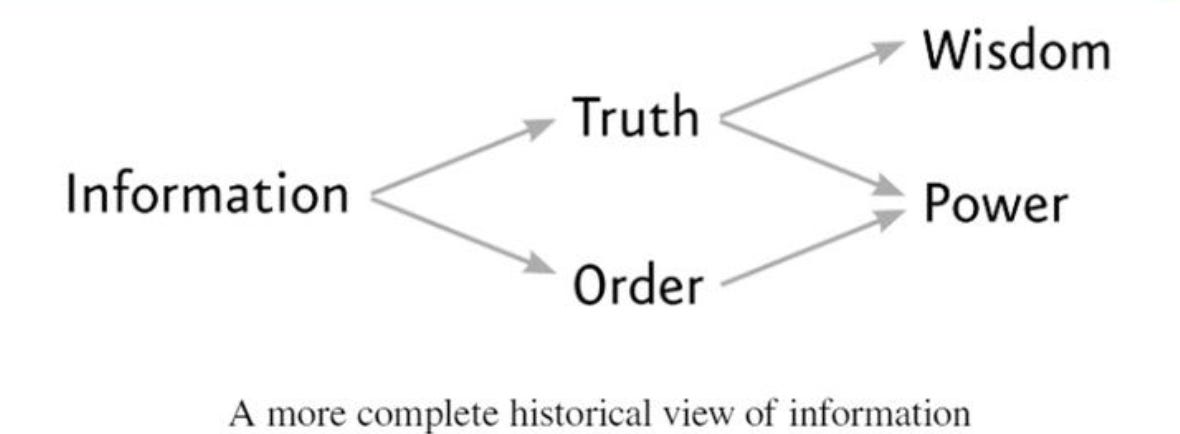
Those who can shape narratives and coordinate action hold the power to build, conquer, and rule.
As our networks have grown more complex—and our challenges more interconnected—raw power has become insufficient. Today, the old logic of domination and extraction leaves us brittle in the face of complexity and ecological crisis.
Thus, a new spiral is emerging, one that calls us to integrate wisdom and co-creation into our networks:
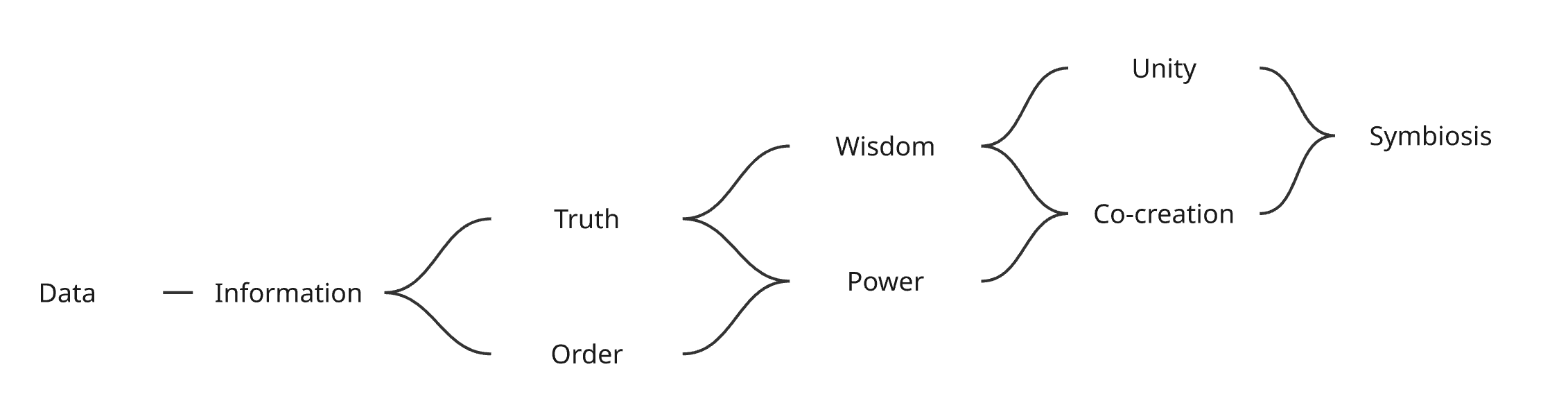
Let’s break this down:
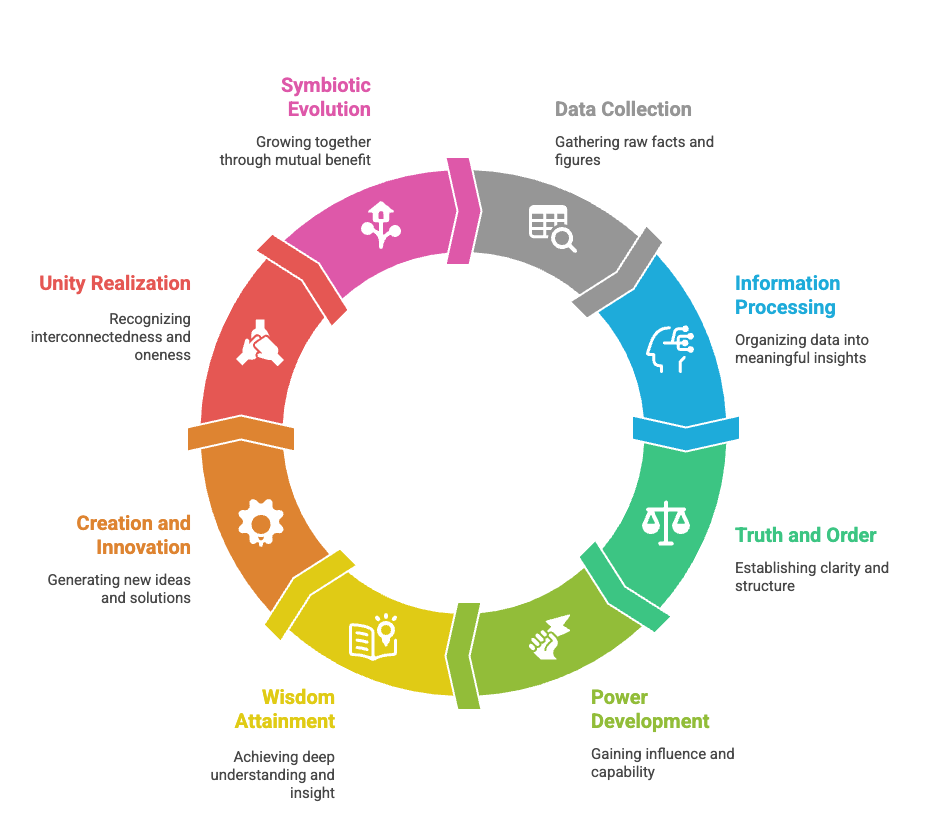
Data is raw, unstructured signal—noise until it is made meaningful.
Information organizes data, but not always truthfully.
Truth & Order arise when information is validated and structured, enabling shared understanding.
Power is the capacity to act at scale, but without wisdom, it can be reckless or harmful.
Wisdom is right action—rooted in context, ethics, and the bigger picture.
Co-creation is what happens when wise actors collaborate—aligning intent, resources, and intelligence to build what none could build alone.
Unity is the shared understanding that we are one. There is no me without we.
Symbiosis is the highest order: a system where many parts act as one, nurturing each other and the whole. Here, networks don’t just extract—they regenerate.
The turning point is wisdom—the leap from “power over” to “power with.”
When we attain wisdom, we begin to move away from controlling the world to becoming in-formation with life itself; from extraction to partnership; from competition to mutual thriving. This is not just an abstract ideal. It’s a concrete challenge:
How do we design networks—digital and social—that don’t just amplify power, but foster wisdom, cooperation, and regenerative capacity?
That is the work of our age. And it begins with transforming how we connect—across every layer of life.
5. The Four Layers of Connection
If symbiosis is our destination, alignment is the road.
Alignment is not a single leap—it’s a living practice that must happen at four interconnected layers of our existence. Each layer is a mirror and a multiplier for the other. A healthy connection at one level enables health at all levels. When any layer breaks, fragmentation ripples upward and outward. The four layers of connection are:
1. Self-to-Self (Inner Alignment)
Connection begins within.
Do I know myself—my values, intentions, shadows, and gifts?
Am I living from truth, integrity, and presence?
Can I sense and adjust when I am out of alignment?
Without inner coherence, everything we project into the world carries our fragmentation with it.
Inner work is not a luxury—it’s the foundation of all outer order.
2. Person-to-Person (Interpersonal Connection)
From inner alignment flows true relationship.
Can I listen deeply, see the humanity in others, and communicate with clarity?
Do I build trust through openness, empathy, and shared vulnerability?
Can I resolve conflict and grow beyond difference?
This is the realm where trust is earned and meaning is co-created. It’s where collaboration and innovation become possible.
3. Organization-to-Organization (Collaborative Structures)
Aligned individuals form resilient groups: teams, communities, companies.
Are our structures clear, fair, and adaptive?
Do we have shared language, goals, and decision-making protocols?
Can we balance autonomy with coherence—honouring both the individual and the collective?
Healthy organisations are not just efficient—they are alive. They sense, learn, and adapt together.
4. Ecosystem-to-Ecosystem (Civilizational/Planetary Alignment)
At the widest scale, organisations must connect in ways that nurture the whole.
Can we coordinate across sectors, cultures, and borders for the good of all life?
Are we capable of agreeing on what is worth protecting and cultivating—planetary health, justice, and regeneration?
Can we create a collective sense of meaning and belonging?
This is the layer where policy, infrastructure, and planetary stewardship come alive. Here, symbiosis is not a metaphor—it is an operating principle.
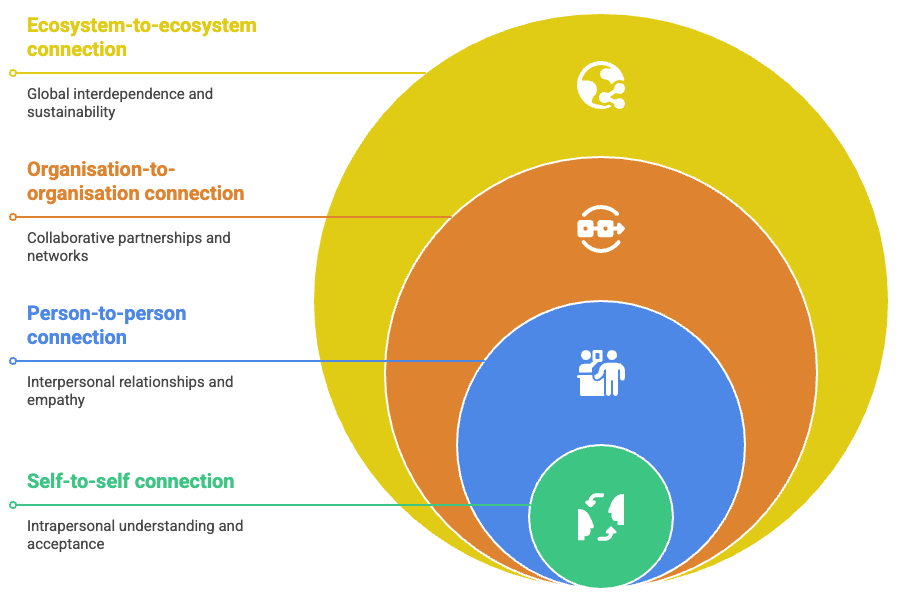
If one layer is broken, trust collapses, context is lost, and our ability to act together unravels.
When all four layers are healthy, something extraordinary happens:
We become more than the sum of our parts—capable of intelligence, adaptability, and regeneration at every scale.
This is the meaning of Sumbios
This is our challenge and our invitation. To build the future, we must weave these layers into a living, adaptive system—one that is wise enough to serve life, not just power.
6. The New Possibility: The Symbiotic Revolution
For centuries, progress has been measured by our ability to dominate, extract, and outcompete. But a new horizon is emerging—one where thriving means something more: the capacity to live, create, and regenerate together.
This is the symbiotic revolution.
It’s a revolution not of force, but of relationship—a fundamental reorientation in how we organise ourselves, our technologies, and our societies.
What Makes This Moment Different?
AI and planetary-scale systems now give us the capacity to coordinate and sense at a level never before possible. We can see the whole—track flows, anticipate disruption, and design for emergence, not just control.
Interdependence is reality. The health of one is inseparable from the health of all. Our fates—individual, organisational, ecological—are intertwined, whether we acknowledge it or not.
Embodiment over abstraction. It’s no longer enough to know or connect—we must become the very change we seek.
Alignment, compassion, and wisdom are no longer luxuries—they are survival skills.
What Does Symbiosis Look Like?
Internally: Individuals cultivate self-awareness, integrity, and purpose.
Interpersonally: Relationships are built on trust, openness, and mutual growth.
Organizationally: Teams and companies align on values, share resources, and innovate collaboratively.
Systemically: Networks of organisations and nations coordinate for planetary health, equity, and regeneration.
In this new paradigm, technology is not a replacement for humanity—but a multiplier of our capacity for meaning, healing, and collective intelligence. The symbiotic revolution is not about controlling the world. It’s about becoming in-formation with life—contributing to, and drawing from, the greater whole.
The choice before us is clear:
Continue down the path of competition, control, and extraction—or step into the adventure of co-creation, regeneration, and symbiotic flourishing.
This is not just a possibility. It is a call—a turning point in our story.
7. Closing Invitation
We stand at a threshold.
For generations, we’ve mastered the art of connecting through technology—expanding our reach, accelerating our progress, and multiplying our collective power. Yet the ultimate leap is still before us:
Will we master the art of connection through consciousness, compassion, and collective wisdom?
The age of information gave us access.
The age of wisdom asks for embodiment.
The age of symbiosis calls us home.
This is an invitation to everyone who senses that something deeper is possible—who sees that our challenges are not just technological, but relational and spiritual. It is a call to architects, innovators, leaders, and citizens: To build networks, organisations, and cultures that serve life—not just profit or power.
The path forward is not easy, but it is open. It begins with small acts of alignment—within ourselves, with each other, and with the living world. It grows through courage: the willingness to question old structures, to repair what’s broken, and to imagine what has not yet been built.
The future will belong to those who can connect—wisely, bravely, and in service to something greater than themselves.
So, will we keep building bigger machines?
Or will we become the living network—a symbiotic intelligence—capable of healing, regenerating, and reimagining our world?
The revolution is not somewhere out there.
It starts here.
It starts now.
And it starts with us.
Join the Symbiotic Revolution
If this vision resonates with you—if you feel called to co-create a future of deeper meaning, connection, and regenerative impact—I invite you to join us.
Whether you’re an innovator, organiser, artist, technologist, or simply someone with an open heart, your presence matters, together, we can weave the networks, ideas, and relationships that will shape the age of symbiosis.
Sign up below to:
Join the community and receive updates
Get early access to events, projects, and tools
Connect with others on the path of symbiotic leadership and change
https://sumbios.notion.site/245b92c1505580999002e4e69fdc7349?pvs=105
Signed up. I think you’re the first other writer here who’s acknowledged connection as the key. Happy to be *connected* now!
Hi Paolo! Thank you for sharing - that was truly an inspiring post:) currently I’m working on a project where we build connections between global changemaker form the global north and local regenerative organisations from the global south. Our core idea builds on human connection and facilitate mutual exchange. Would love to stay in contact.